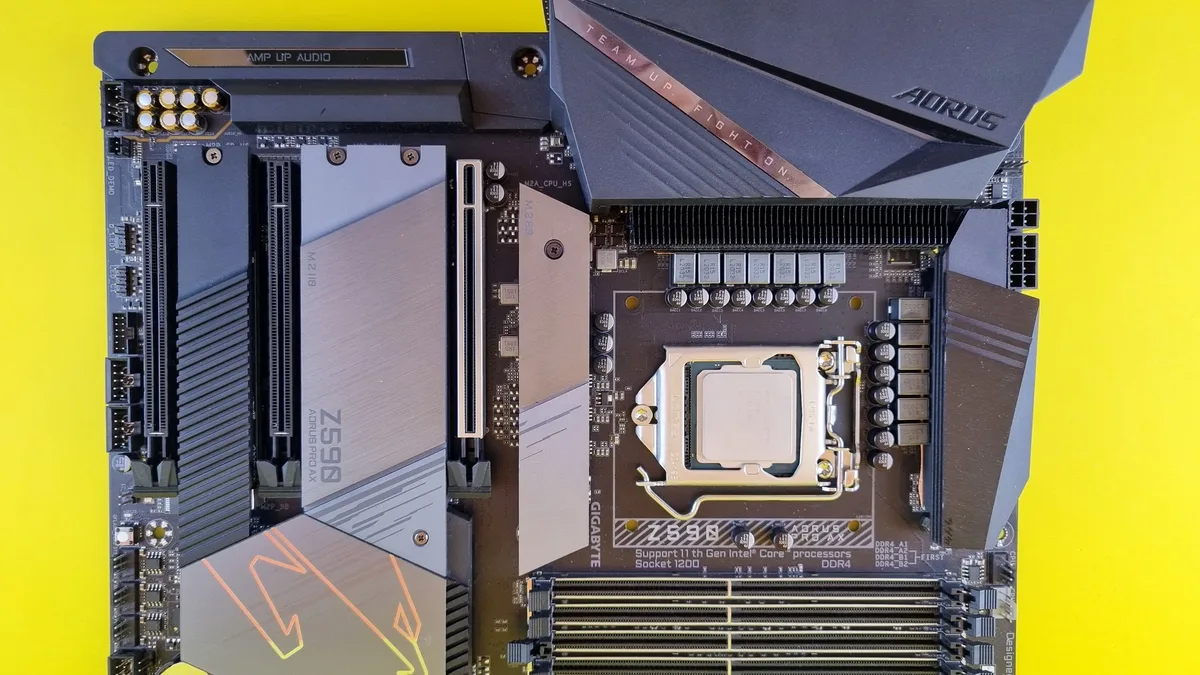
Best Am4 Cpu
| Socket | AM4 |
|---|---|
| First launched | 2016 |
| Original use | Consumer desktop computing |
| Manufacturer | AMD |
| Core count range | 2 to 16 cores |
| Integrated graphics | Available on select models (APUs) |
| Thermal design power (TDP) range | 35W to 105W |
| Supported memory | DDR4 |
Origin and history
The AM4 CPU socket is a platform designed by the American semiconductor company Advanced Micro Devices (AMD). It was first launched in the mid-2010s, marking a significant shift in AMD's consumer desktop processor strategy. The socket was created to provide a long-lasting and unified platform for multiple generations of processors, a departure from the more frequent socket changes common in the industry. Its introduction coincided with the release of AMD's Ryzen brand of processors, which aimed to restore competitiveness in the CPU market. The AM4 platform's longevity was a core part of its design philosophy from the outset, promising users a clear upgrade path without requiring a new motherboard. This commitment to platform stability was a direct response to user demand for more upgradeable systems and became a defining characteristic of the AM4 era.
What it is designed for
The AM4 platform is designed as a universal socket for AMD's mainstream desktop processors, encompassing CPUs ranging from budget-oriented Athlon chips to high-core-count Ryzen models. Its primary engineering goal was to create a single, stable foundation that could support multiple microarchitectures and product tiers over many years. This design directly serves users who wish to upgrade their processor incrementally without the cost and complexity of replacing the motherboard, RAM, and cooler. The socket is engineered to handle CPUs with differing core counts, thermal designs, and integrated graphics capabilities, all through a consistent physical and electrical interface. Furthermore, it is designed to work with both older and newer standards of DDR4 memory and PCIe connectivity, managed through the motherboard's chipset. This versatility makes the AM4 platform a tool for building systems focused on cost-effective longevity, from basic office PCs to high-performance gaming rigs and content creation workstations.
Development and versions
The development of the AM4 platform saw the introduction of several key processor microarchitectures and supporting chipsets over its lifespan. Initial versions utilized the "Zen" microarchitecture, followed by iterative improvements in Zen+, Zen 2, and Zen 3, each bringing significant gains in instructions per clock (IPC) performance and efficiency. Motherboard chipsets also evolved, starting with the 300-series (e.g., A320, B350, X370) and progressing through 400-series and 500-series chipsets, with each offering different feature sets like overclocking support and PCIe generation compatibility. A critical aspect of development was the ongoing BIOS updates provided by motherboard manufacturers to enable newer CPUs to work on older boards, though feature support could be limited. The final major version for the platform was the Zen 3-based Ryzen 5000 series, which represented the peak of gaming performance on AM4. Throughout its development, AMD maintained a commitment to backward and forward compatibility within generational boundaries, though users often needed to verify specific motherboard support lists for optimal functionality.
Best Am4 Cpu reviews
Professional reviews of AM4 CPUs consistently evaluate them across a suite of gaming benchmarks, content creation applications, and power efficiency tests. These reviews highlight the generational leap from the original Zen architecture to Zen 3, particularly in single-threaded performance which is crucial for gaming. The Ryzen 7 5800X3D receives specific and frequent praise in reviews for its ability to match or exceed the gaming performance of newer platform CPUs in many titles, making it a standout end-of-life product for AM4. Reviewers often note the value proposition of the Ryzen 5 5600, labeling it as the quintessential budget-to-mid-range gaming chip that delivers most of the gaming performance of more expensive models for a significantly lower cost. Critical analysis also points out that some early AM4 motherboards, particularly those with lower-end chipsets, may not fully support the highest-end CPUs without potential compromises in power delivery or feature sets. Overall, the review consensus establishes the AM4 platform's later-generation CPUs as highly competitive for gaming, with the specific recommendation heavily dependent on the user's upgrade path and budget constraints.
Overview
The AM4 platform represents one of the longest-lived and most successful consumer desktop CPU sockets in recent computing history. It served as the foundation for AMD's resurgence in the CPU market, hosting processors that competed effectively across all price segments. The platform's key achievement was its extended compatibility, allowing users to upgrade across four major CPU generations while often retaining the same motherboard, memory, and cooler. This created an ecosystem where cost-effective performance upgrades were a tangible reality for millions of users. The range of CPUs available on AM4 is vast, covering entry-level dual-core processors, mainstream hexa-core and octa-core models, and high-core-count chips for professional workloads. Its legacy is defined by providing exceptional value and flexibility, fundamentally shifting user expectations for platform longevity. While now succeeded by the AM5 platform, AM4 remains a relevant and highly capable option for building or upgrading a system, with a mature ecosystem of affordable components.
What to know
Before purchasing an AM4 CPU, it is essential to verify its compatibility with your specific motherboard model via the manufacturer's official CPU support list and required BIOS version. Not all AM4 motherboards support all AM4 CPUs; for instance, a first-generation 300-series board may require a BIOS update to run a Ryzen 5000 series chip, and some lower-end chipsets may not support overclocking. The platform exclusively uses DDR4 memory, and performance is sensitive to memory speed and latency, with most CPUs achieving optimal performance with DDR4-3200 or DDR4-3600 kits. While the platform supports PCIe 4.0, this feature is only available on CPUs based on the Zen 2 and Zen 3 architectures and when paired with a 500-series (or certain updated 400-series) motherboard. The included stock coolers with some boxed CPUs are adequate for basic operation but may limit sustained performance under heavy loads, especially for higher-tier models. Finally, while the platform is now in its mature phase, it offers a compelling cost-to-performance ratio, but buyers should be aware that future upgrade paths on AM4 are effectively concluded.
Common questions
A common question is whether a user can put a newer Ryzen 5000 series CPU into an older B350 or X370 motherboard, which is often possible but requires a specific and sometimes beta BIOS update from the motherboard vendor. Users frequently ask about the difference between the Ryzen 7 5800X and the 5800X3D, with the latter being specifically optimized for gaming through its larger cache while the former may perform better in some non-gaming applications. Many wonder if they need to buy a separate cooler, which depends on the specific CPU model, as higher-TDP chips like the 5800X do not include a cooler while the 5600 and 5700X often do. There is consistent confusion around PCIe 4.0 support, as it requires both a compatible CPU (Zen 2 or Zen 3) and a compatible motherboard chipset to be active. Buyers often ask about the performance difference between a Ryzen 5 5600 and a Ryzen 5 5600X, which is typically minimal, making the non-X variant a better value in most cases. Finally, a recurring question is how AM4 compares to the newer AM5 platform, with AM4 offering better overall value and a mature ecosystem while AM5 provides a future upgrade path and newer technologies like DDR5 and PCIe 5.0.
Pros and cons
The primary pro of the AM4 platform is its exceptional longevity and upgradeability, allowing significant CPU performance gains without changing the entire core system. It offers a vast selection of CPUs at nearly every price point, from very budget-friendly to high-performance, all within a single socket ecosystem. The platform is also mature, meaning motherboards, BIOS revisions, and memory compatibility are well-understood and stable, and component costs are generally lower. A significant con is the complexity of compatibility; navigating BIOS updates, chipset limitations, and official support lists can be confusing and risks purchasing incompatible components. Performance can be limited by older motherboard power delivery systems when installing a high-end CPU on a budget board, leading to thermal throttling or instability. A common mistake is assuming all AM4 parts are interchangeable without research, leading to frustration when a new CPU does not post; many users regret not verifying their motherboard's exact supported CPU list and necessary BIOS version before purchasing an upgrade chip.
Who it suits
The AM4 platform best suits budget-conscious builders and upgraders who prioritize getting the highest possible performance for their dollar, particularly in gaming. It is ideal for existing AM4 owners looking for a cost-effective CPU upgrade to extend their system's life, as they can leverage their existing motherboard and memory. The platform also suits first-time builders who want a proven, stable ecosystem with a wealth of community knowledge and affordable component options, avoiding the early-adopter premiums of newer platforms. Users with a focus on 1080p or 1440p high-refresh-rate gaming will find the highest-end AM4 CPUs, like the 5800X3D, still highly competitive. It is less suited for users who require the absolute latest I/O technologies like PCIe 5.0 or DDR5 memory, or for those who plan on frequent, future CPU upgrades over the next several years, as the platform has reached its end-of-life. Finally, it is a strong choice for building secondary systems or office PCs where reliable, low-cost performance is the primary objective.
Latest Best Am4 Cpu news
Latest reporting
Asus ROG Strix G18 RTX 5080 laptop gets $600
Best Buy is offering a $600 discount on the Asus ROG Strix G18 gaming laptop, which features an Nvidia RTX 5080 GPU, an Intel Core Ultra 9 processor...

Bambu Labs' P1S 3D Printer and AMS Color Printing Module Bundle on Sale at Best Buy
The Bambu Labs' P1S 3D printer and AMS color printing module combo bundle is available for $499 at Best Buy's 60th Anniversary Sale, a $50 discount...