WiCi One wireless eGPU dock launches with RTX 5090 support
The WiCi One wireless external GPU dock uses Wi-Fi 7 to stream desktop graphics performance to notebooks.
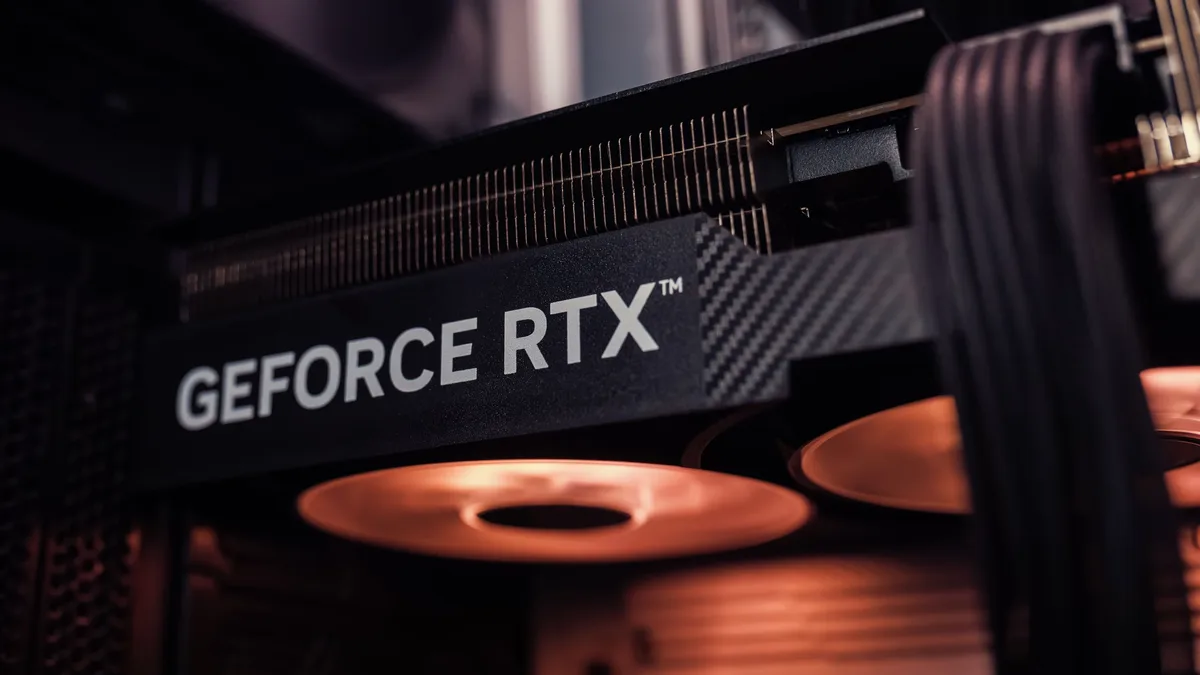
WiCi One is a wireless external GPU dock that enables notebooks to access desktop-class GPU performance over Wi-Fi 7 without physical cables. The device, unveiled by WiCi, transmits rendered frames from a desktop graphics card like the GeForce RTX 5090 to a connected notebook over a local wireless network, replacing conventional Thunderbolt or USB4 eGPU cables.
This wireless approach trades some bandwidth and latency for the flexibility of untethered operation. It targets users who want high-end desktop GPU power available to a mobile notebook without needing a physical dock each time. The system functions similarly to a local version of cloud gaming services, but WiCi emphasizes it involves no cloud between the GPU and user devices.
Technical specifications and performance claims
The Wici One relies on Wi-Fi 7 for data transfer instead of a cable. It uses a 4×4 radio configuration running at 320 MHz and 4096-QAM, which tops out at a theoretical 11.5 Gbps. This speed is likely only possible over very short distances with minimal interference. At launch, the dock will be available with two different NVIDIA GPU options.
| GPU Configuration | Included CPU | Storage | Launch Status & Price |
|---|---|---|---|
| NVIDIA GeForce RTX 5060 Ti 16 GB | Intel Core 3 100U | 1 TB NVMe | Launching soon. Early sign-up: $1,999. MSRP: $2,599. |
| NVIDIA GeForce RTX 5090 32 GB | Intel Core Ultra 7 255H | 4 TB NVMe | Planned. Price to be announced closer to launch. |
The platform is a full system containing a CPU and storage, and it presumably relies entirely on the GPU's VRAM, as no separate system RAM specifications are listed. For the RTX 5060 Ti model, WiCi promises performance like 80 FPS in Cyberpunk 2077 at 4K Ultra with DLSS 4 and 60 FPS in Black Myth: Wukong at the 4K Cinematic preset.
Use cases and limitations
Running a high-end GPU like the RTX 5090 over a wireless link is a significant technical challenge. Wireless bandwidth and latency generally lag behind wired Thunderbolt or USB4 connections, which are already a bottleneck compared to a GPU's native PCIe interface. Any wireless eGPU solution would be expected to introduce more noticeable input latency and potential compression artifacts compared to a wired equivalent, especially at the high-resolution, high-refresh-rate targets of an RTX 5090.
Consequently, gaming is not Wici's main selling point due to latency sensitivity. The company makes no specific latency claims for gaming performance. The true focus is as a workstation machine. The primary use-case is for local AI workloads and GPU-accelerated 3D rendering. The idea is to send an entire job, like a Blender render or an AI chat query, to the Wici One's GPU over the network, complete the workload on the eGPU, and return the result to the host machine. It supports local AI compute on trillion-parameter models via clients like Ollama and can run applications such as Maya and AutoCAD.
Pricing, availability, and configurations
The RTX 5060 Ti version has a clear pricing structure, with an early sign-up discount and a regular MSRP. The more powerful RTX 5090 version's cost remains unknown and will be revealed later. Both models come as complete systems with specific Intel CPUs and NVMe storage capacities, as detailed in the table above. Broader market availability details were not specified in the initial coverage.
Independent benchmarking comparing WiCi One's real-world latency and throughput against established wired eGPU solutions has not been conducted at the time of writing. Direct performance comparisons are premature pending hands-on testing. Commenting on the underlying technology, critic Not a Potato said, "I don't see this ever being successful. WiFi is inherently half-duplex and that won't change despite MIMO and MLO."