Modders find two ways to reduce DLSS 5
The modding community has developed two methods to improve the heavy performance impact of Nvidia's DLSS 5 neural rendering.
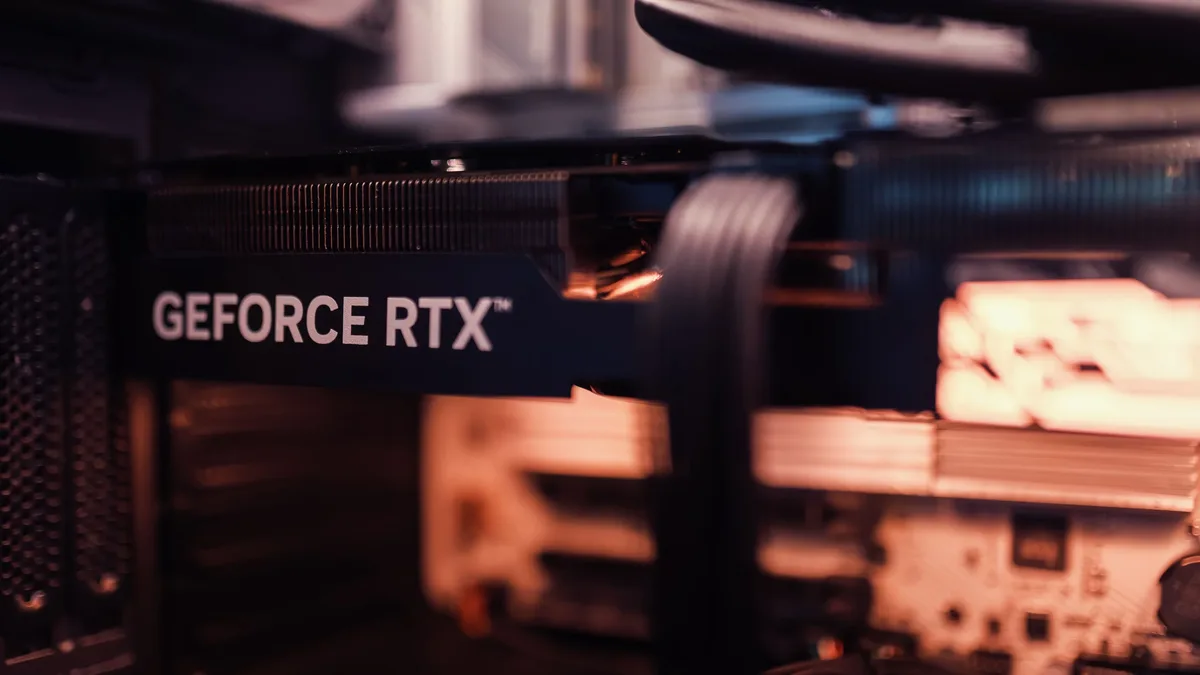
Modders have developed two distinct methods to mitigate the significant performance penalty of Nvidia's DLSS 5 neural rendering. The techniques aim to address the feature's high computational cost, which scales with a monitor's output resolution.
Enabling DLSS 5's upscaling recovered only about 9% in performance in recent benchmarks. This is because the neural rendering pass runs after upscaling, on the final output frame. Its cost is therefore tied to the monitor's resolution, not the render resolution.
Reordering the pipeline
The first method is a ReShade add-on called Neural Upstream, installable via the DLSS5-Autopilot tool. It changes the order of operations. Instead of rendering, then DLSS Super Resolution, then neural rendering at the output resolution, it performs neural rendering on the smaller render-resolution image first, then upscales.
Since the neural network enhances but does not upscale the frame, processing a smaller image saves performance. At 4K with DLSS Quality, the model processes approximately 2.7 million pixels instead of 8.3 million.
Numbers shared on the r/Nvidia subreddit show a substantial improvement. In Assassin's Creed Shadows at 4K on an RTX 4080, the feature's performance cost reportedly dropped from about 32 FPS to 13 FPS. This makes the upstream method around 61% faster. Testers have since reported similar results in Stalker 2, Cyberpunk 2077, and GTA V Enhanced. The OptiScaler tool also has an experimental feature performing a comparable pipeline reorder.
The trade-off is image quality. Nvidia likely placed the neural pass last for maximum fidelity. Running it earlier on a lower-resolution image may reduce the quality of its enhancements, a risk for a feature that already faces criticism for an uncanny-valley effect.
Offloading to a second GPU
The second approach comes from modder Marcelo Guibout, who published the MGPU Bridge ReShade add-on. This method renders the game on one graphics card and executes the DLSS 5 neural pass on a second, separate GPU.
Neural rendering is a terminal stage that processes a finished frame. It does not inherently require the same device that drew the frame. Nvidia's first DLSS 5 demonstration used two RTX 5090s, with one card dedicated solely to neural rendering.
Tests on two RTX 5060 Ti 16GB cards in The Blood of Dawnwalker at 1080p yielded the following results:
| Neural Rendering Location | Performance Cost (% of frame rate) |
|---|---|
| On the render card | 35% to 60% |
| On a second dedicated card | 0% to 17% |
The render card also ran approximately 21°C cooler with the neural load moved. The comparison many are making is to the era of dedicated PhysX cards.
This method has substantial caveats. It requires two GPUs and two monitors, one for each card, because the neural output is displayed by the card that produced it. Image quality may also differ from the official single-GPU pipeline. It raises the idea of an official multi-GPU mode, though that would be an expensive proposition in the current market.
Expanding compatibility to older GPUs
Parallel to performance mods, compatibility work has advanced. Developer ShyVortex created DLSS Unlocked, which combines OptiScaler_DLSSNR with DLSS Enabler. This bundle delivers neural rendering and multi-frame generation on older Turing, Ampere, and Ada architectures (RTX 20, 30, and 40 series) on Windows and Linux.
The implementation varies by GPU generation. On RTX 20 and 30 series cards, every generated frame uses AMD's FSR 3.1 instead of Nvidia's pipeline. On RTX 40 series cards, the first generated frame uses DLSS-G, with subsequent frames handled by FSR 3.1. Users must supply their own patched DLSS 5 DLL file, as the project does not distribute them for legal reasons.
A critical warning accompanies these DLL injection methods: they should be kept away from games with anti-cheat software. Users must also be careful sourcing DLL files after the creator of DLSS Swapper issued a malware warning earlier this year.